What is Vibe Coding? The Complete Beginner's Guide for 2026
By Webcore Solutions | May 22, 2026 | 12 min read
Something significant is quietly changing in software development and it doesn't look like anything we've seen before.
No more late nights staring at cryptic error messages. No more months-long build cycles before a single feature ships. No more being at the mercy of a developer shortage that slows everything down.
Instead, a founder types a sentence. An AI builds an app.
That's the world of vibe coding and whether you're a seasoned developer, a business owner, or someone who's never touched a line of code, this guide breaks down everything you need to know: what it is, how it works, who it's actually for, and where it's headed.
Let's get into it.
What is Vibe Coding?
Vibe coding is a way of building software by describing what you want in plain English and letting artificial intelligence handle the actual code.
You don't write functions. You don't wrestle with database configs. You don't debug syntax errors at 2 a.m. You describe the outcome you want, and an AI translates that into working, functional software.
The term was coined by Andrej Karpathy co-founder of OpenAI and former Director of AI at Tesla in February 2025. He described it as a new mode of building where you "fully give in to the vibes, embrace exponentials, and forget that the code even exists."
At the time, it sounded almost poetic. By 2026, it's simply how a growing share of the world's software gets built.
How Did We Get Here?
To really understand vibe coding, you need to understand the shift that made it possible.
For decades, building software meant being fluent in programming languages Python, JavaScript, SQL, and dozens more. That technical wall meant only a narrow slice of the population could actually build digital products. If you had an idea for an app, your options were: learn to code (a multi-year commitment), hire a developer (expensive and slow), or shelve the idea entirely.
AI changed the equation entirely.
Large language models the same technology behind ChatGPT, Claude, and Gemini turned out to be extraordinarily good at understanding intent and generating code. You don't need to think in Python anymore. You just need to think in English.
The result was a completely new category of software development one that didn't exist five years ago and is now reshaping the entire industry.
The Numbers Tell the Story
If vibe coding still sounds like a niche experiment for tech enthusiasts, the data tells a different story.
- 92% of US developers now use AI coding tools on a daily basis (GitHub, 2026)
- 41% of all code written globally is now AI-generated
- The vibe coding tools market hit $4.7 billion in 2026, growing at 38% annually — already larger than the entire traditional code editor market
- Gartner forecasts that 60% of all new software code will be AI-generated by the close of 2026
- Google Trends recorded a 2,400% increase in searches for "vibe coding" since January 2025
- Collins Dictionary named "vibe coding" its Word of the Year for 2025
These aren't predictions anymore. This is the new baseline.
How Does Vibe Coding Actually Work?
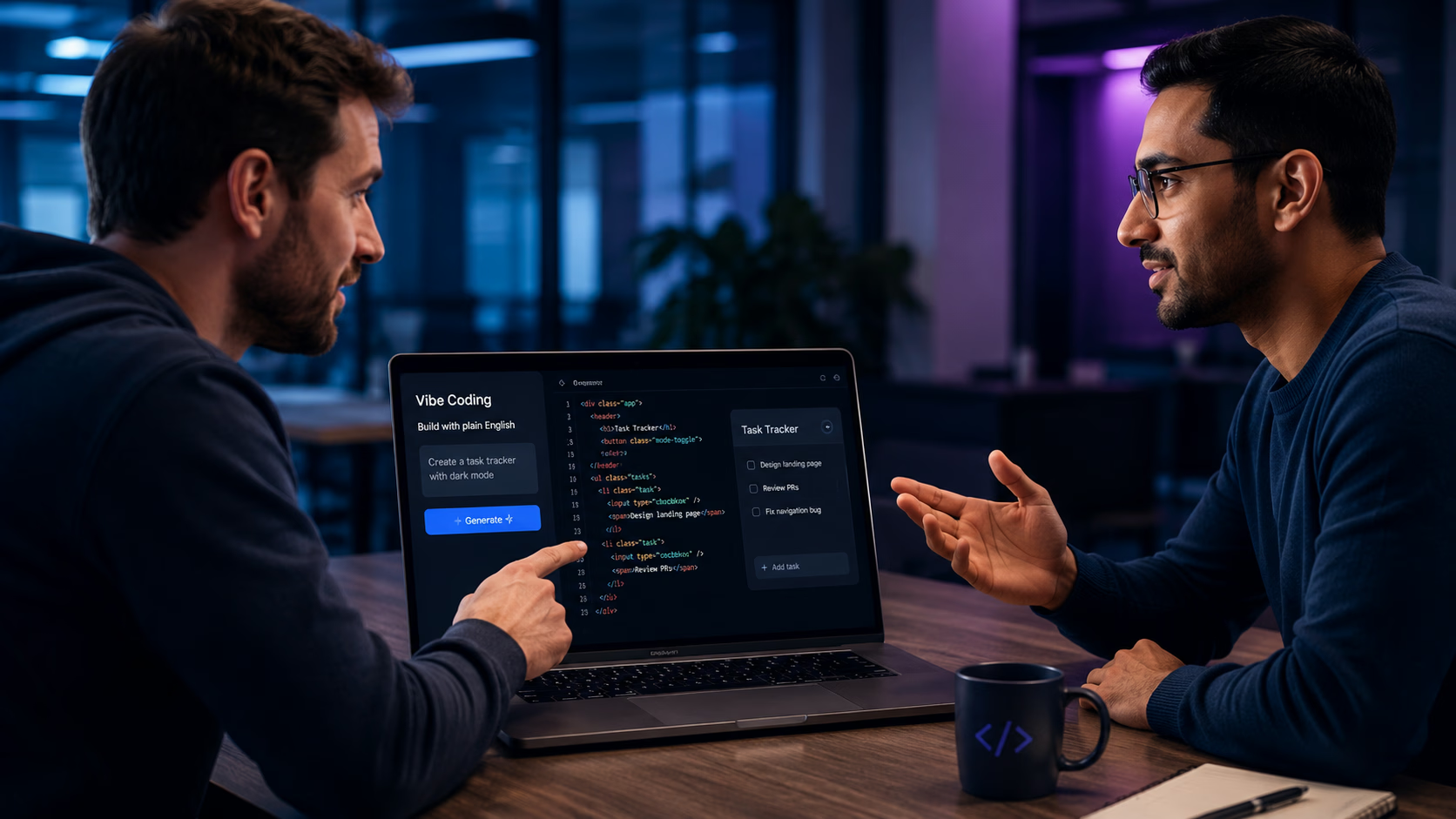
Here's the short version: you describe what you want, the AI builds it, you review and refine.
In practice, modern vibe coding tools have evolved into something significantly more capable. Here's what a typical workflow looks like:
Step 1 : You Describe Your Intent
You write a prompt in plain English. Something like:
"Build me a customer dashboard with login, a table showing recent orders, and a button to export data as a CSV."
Simple or detailed the AI handles both.
Step 2: The AI Generates the Code
The tool interprets your prompt and generates complete, functional code — not just snippets, but entire components, database schemas, API connections, and UI layouts. In modern tools, this often takes seconds.
Step 3: You Review and Iterate
You see the result in real time. If something's off, you describe the fix:
"Make the table sortable by date" or "Change the button colour to blue."
No rewriting. No manual debugging. You keep describing what you want until it matches your vision.
Step 4: You Deploy
Many vibe coding platforms can deploy your application with a single click. What once required a team of developers and weeks of work can now be done by one person in a matter of hours.
Vibe Coding vs. Traditional Coding vs. No-Code
These three get confused regularly. Here's a clear breakdown:
| Vibe Coding | Traditional Coding | No-Code (e.g. Bubble) | |
|---|---|---|---|
| How you build | Describe in plain English | Write code manually | Drag and drop |
| Output | Real, custom source code | Real, custom source code | Platform-locked templates |
| Flexibility | Very high | Unlimited | Limited |
| Speed | Very fast | Slow | Fast |
| Skill required | Low | High | Low–Medium |
| Best for | MVPs, prototypes, internal tools | Complex systems, critical infrastructure | Simple websites, basic apps |
The key distinction: unlike no-code tools, vibe coding produces actual source code React, Python, Swift, whatever your project needs. You own it. You can export it. There's no platform lock-in.
Who is Vibe Coding Actually For?
The honest answer: most people. Here's a breakdown by use case.
Non-Technical Founders and Entrepreneurs
You have a business idea but no development team. Vibe coding lets you go from concept to working prototype in days rather than months. You can test demand, gather real user feedback, and iterate before spending anything on traditional development.
Developers and Engineers
Even experienced developers are adopting vibe coding not to replace their skills, but to amplify them. The mechanical, repetitive parts of coding (boilerplate, routine components, documentation) can now be handled by AI, freeing up engineers to focus on architecture, design decisions, and the work that genuinely requires human judgment.
Product Managers and Designers
You know exactly what you want to build. Now you can build a functional prototype yourself, without waiting for a dev sprint to open up. Show stakeholders something real not just wireframes.
Small Business Owners
Need an internal tool? A custom booking system? A client portal? Vibe coding means you don't need to hire a full agency for straightforward business tools. You can have something working in days, at a fraction of the cost.
The Best Vibe Coding Tools in 2026
The tool landscape has grown quickly. Here are the most widely used platforms right now:
Cursor
The AI-native code editor that's become the go-to for developers who vibe code. It sits inside your codebase, understands your full project context, and can refactor, explain, and generate with remarkable accuracy. Best for developers comfortable working in a code environment.
Bolt.new
A browser-based tool for building full-stack web applications from a single prompt. Excellent for non-technical founders who want something deployed quickly with zero setup. Great for MVPs and early prototypes.
Lovable
Built specifically for product builders. You describe your app; Lovable generates a complete, deployable product frontend, backend, and database all from natural language.
GitHub Copilot
Microsoft's AI coding assistant lives inside your existing editor and suggests code as you type. Used by 92% of professional developers in some form. Less "describe and build," more "AI-assisted traditional coding."
Replit
A browser-based development environment with strong AI capabilities. Great for beginners and teams who want a collaborative, cloud-first experience.
v0 by Vercel
Specialises in generating polished, production-ready UI components. Paste a description or even a screenshot and v0 produces clean React and Tailwind code almost instantly.
Claude Code
Anthropic's agentic coding tool that works in your terminal and handles complex, multi-file projects. Particularly strong at understanding context and managing longer, more nuanced development tasks.
What People Are Actually Building
Vibe coding isn't theoretical. Here's what's already being shipped:
Tim Lorent, a senior front-end developer, delivered Dunzo a complete task management system in just 48 hours using vibe coding tools.
Lee Durbin built Mindarin, a fully functional Chinese learning app, starting with an MVP in a single day and later migrating it to a modern stack with full test coverage all with AI assistance.
Y Combinator's Winter 2025 cohort revealed that 25% of the startups in the batch were running codebases that were 95% AI-generated. These weren't hobbyists. These were funded companies.
Meanwhile, IBM reported that internal tools built using vibe coding techniques reduced enterprise development time by 60%.
The Honest Limitations: What Vibe Coding Can't Do
Giving you only the upside would be a disservice. Vibe coding is genuinely powerful but it has real limitations worth understanding before you rely on it.
Security Is a Serious Concern
This is the big one. AI code generators optimise for functionality, not security. They produce code that works, but "works" and "works safely" are two very different things.
A Stanford study found that developers using AI tools wrote less secure code than those who didn't while simultaneously feeling more confident it was secure. That combination is genuinely dangerous.
Real consequences are already emerging. Wiz scanned 5,600 vibe-coded apps and found over 2,000 vulnerabilities and 400 exposed secrets including hardcoded API keys and live credentials. One well-known app reached $1 million in revenue and earned an Oprah mention before researchers discovered its database was publicly readable, putting 39,000 users' data at risk.
Technical Debt Accumulates Quickly
AI-generated code tends to be repetitive and structurally inconsistent. GitClear data shows a 60% drop in refactoring since 2021, while code duplication has quadrupled. The speed you gain upfront can cost you significantly in maintenance later.
The Last 20% Is the Hard Part
Vibe coding reliably handles the first 80% of a project in hours. The remaining 20% the part that makes software production-ready, handles edge cases properly, performs under real load, and scales reliably — still demands genuine engineering expertise.
It's Not the Right Tool for Everything
Complex financial systems, healthcare software, real-time infrastructure, and applications where failure carries serious consequences still require traditional engineering rigour. Vibe coding is a powerful starting point, not a universal solution.
How to Vibe Code Responsibly: 5 Rules That Matter
If you're going to use vibe coding and you probably should be here's how to do it without creating problems for yourself down the line.
1. Always review what gets deployed. 96% of developers don't fully trust AI-generated code, yet only 48% consistently review it before pushing to production. Be in that 48%. A five-minute review catches most obvious issues.
2. Never hardcode secrets. AI models frequently embed API keys, passwords, and credentials directly into code. Always use environment variables and check for exposed secrets before launch every time.
3. Use version control from day one. Commit your working state before any major AI-driven change. If the AI introduces a bug or breaks something, you need a clean rollback point.
4. Treat prototypes as prototypes. A vibe-coded MVP is excellent for validation. It is not production infrastructure. When your product gains real traction, invest in a proper engineering review before you scale.
5. Combine AI speed with human expertise. The best results come from pairing vibe coding's pace with sound engineering judgment. Use AI to generate; use humans to architect, review, and secure.
The Bigger Picture: What This Means for Software Development
Vibe coding isn't just changing how developers work. It's changing who gets to build software at all.
People who never considered themselves technical are now building tools, automating workflows, and launching products. The distance between "having an idea" and "having a working product" has never been shorter.
At the same time, the role of skilled engineers isn't disappearing it's evolving. The industry is seeing the rise of what some are calling the "product engineer": someone who combines business understanding, design thinking, and technical oversight to direct AI systems toward high-quality outcomes. The most valuable developers in 2026 aren't those who write the most code. They're the ones who architect the best systems and ask the sharpest questions.
The vibe coding market is projected to grow from $2.96 billion in 2025 to $325 billion by 2040. This is not a passing trend.
Final Thoughts: Should You Be Using Vibe Coding?
If you're a founder or business owner: almost certainly yes. The speed advantage alone compressing weeks of development into days is too significant to ignore. Use it to test ideas, build internal tools, and validate products before committing to full development investment.
If you're a developer: also yes. Not because it replaces what you do, but because it handles the tedious parts and frees you to do the work only humans can do well.
If you're a business considering vibe coding for a serious, customer-facing product: proceed thoughtfully. Use it to prototype and validate. Then bring in professional development expertise to make it production-ready, secure, and scalable.
The smartest approach in 2026 isn't "vibe coding versus traditional development." It's knowing when to use each and having the expertise to bridge them.
How Webcore Solutions Approaches AI-Assisted Development
At Webcore Solutions, we've been watching the vibe coding revolution closely and integrating the best of it into how we work.
We use AI-assisted development to accelerate delivery and reduce costs for our clients. But we pair that speed with the engineering rigour, security practices, and architectural thinking that production software demands. The result: products that ship faster and hold up under real-world conditions.
Whether you're starting from scratch, have a vibe-coded prototype that needs hardening, or simply want to understand what AI-assisted development means for your business we'd love to have that conversation.
Ready to build?
Let's turn the idea into something shipped.